
Out past the Canton city limits, the water meter is rarely a few steps from the porch. It usually sits in a plastic box beside the county road. The pipe that carries water to the house may run 200 or 400 feet, sometimes close to a thousand. It crosses pasture, passes under a gravel drive, goes past the barn and follows a fence line before it reaches a faucet. That stretch of buried pipe is easy to forget. It’s also the part of the system most rural homeowners know least about, even though they own it.
Most of the rural water supply corporations across Van Zandt County began in the 1960s as member-owned systems serving homes and farms. Their responsibility generally ends at the meter. Everything on the customer side of the meter belongs to the property owner, all the way to the house. So does every repair bill that comes with it.
That surprises many people the first time a water bill doubles for no clear reason. When the cause turns out to be somewhere under a hayfield, the team at Elephant Plumbing in Canton handles this kind of work. They find leaks with modern locating equipment and replace sewer and water lines without tearing up most of the yard. Still, knowing how these long lines behave helps any homeowner catch problems while they’re small.
Distance Changes Everything
A suburban service line might stretch thirty or forty feet. A rural one can be ten or twenty times that long, and the extra length matters. More pipe means more joints, and every glued or clamped joint is a place where a leak can start. A longer line also crosses more kinds of ground, from sandy loam near the road to heavy clay by the house. And a slow leak can soak into the soil for weeks without ever showing up where someone would notice.
Pressure plays a part too. Rural systems push water across rolling terrain, so a home in a low spot can get pressure well above what household plumbing handles comfortably. Plumbing codes generally call for a pressure reducing valve once static pressure goes above 80 psi, but plenty of older country homes never got one. That constant strain wears on joints, fittings, toilet fill valves and water heaters.
What the Soil Does to Buried Pipe
East Texas soil is hard on pipe. Much of Van Zandt County sits on claypan and blackland soils that swell when wet and shrink and crack when dry. A plastic line buried in that ground gets squeezed and released through every wet spring and dry August. Over the years, that movement can loosen joints or crack the pipe at a rigid fitting that can’t flex.
Shallow burial adds to the risk. Hard freezes are rare here, so many lines were laid only a foot or so deep. That was usually fine until February 2021, when Winter Storm Uri kept much of Texas below freezing for days. Shallow lines, exposed risers and above-ground runs to barns split open. Many rural owners still have repairs from that week under their yards, and some were done in a hurry.
Work done on the surface can damage the line too. Driving T-posts for a new fence, setting a gate post, grading the drive with a box blade or parking a loaded trailer on soft ground can crush or nick a line nobody remembered was there.
Signs of a Leak in the Yard
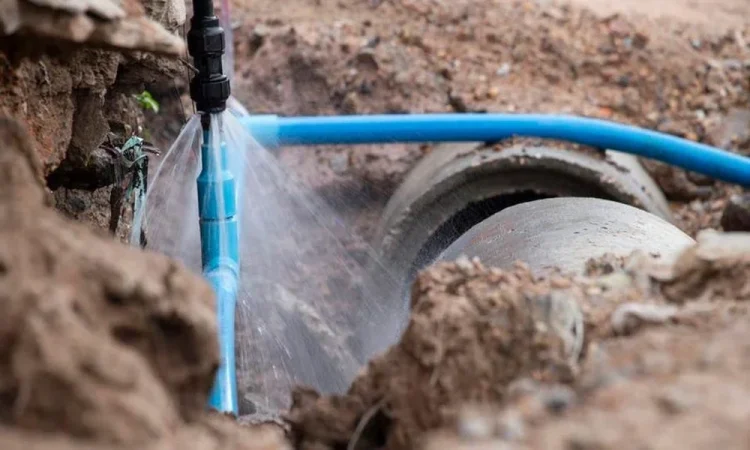
Underground leaks rarely show up as a gush of water. The signs are usually small. Watch for these:
- A strip of grass that stays greener than the rest, especially in a dry spell
- A soft or sunken patch in the pasture or driveway that never fully dries
- Standing water in the meter box when it hasn’t rained
- Water pressure at the house that has slowly dropped over several months
- A monthly bill that keeps creeping up even though your water use hasn’t changed
The meter is the simplest tool for checking. Turn off every fixture, then watch the small low-flow indicator on the meter face. If it moves, water is going somewhere. Then close the main shutoff at the house. If the indicator still moves, the leak is in the buried line. The City of Midland’s leak detection guide describes the same test. It warns that a leak in a pressurized service line can waste more than 10,000 gallons in a few days, which is why the guide treats it as an urgent repair.
Branch Lines Nobody Mapped
Country properties rarely have just one line. Over the decades, owners add branches off the main line to feed a stock tank, a shop, a garden hydrant, a chicken coop, an RV pad or a second home for a parent. Whoever owned the place at the time usually added them, often with whatever pipe was on hand, and almost nobody wrote them down.
When the meter keeps spinning, a forgotten branch is often the cause. A float valve stuck open on a cattle trough can waste as much water as a broken pipe. It’s worth putting a separate shutoff valve at the start of every branch. Then you can close one section at a time to find where the water is going. You can also shut off an outbuilding for winter without cutting water to the house.
The Pipe Under Older Homes
What the line is made of says a lot about how much life it has left.
PVC
PVC has been the most common choice for rural lines since the 1970s. It holds up well when laid on proper sand bedding. The weak spots are thin-wall pipe, rocky backfill and joints glued in cold weather.
Polyethylene
Flexible black or blue poly pipe handles soil movement better than PVC. It comes in long coils, so a line needs fewer joints. Older, cheaper poly can turn brittle, though, and the insert fittings held with hose clamps are a common place for leaks.
Polybutylene and galvanized steel
Gray polybutylene was installed from the late 1970s to the mid-1990s and tends to break down from the inside. Old galvanized pipe in some farmhouses slowly rusts closed. Either material usually means the line is near the end of its life.
Repair, Reroute or Replace
A single leak on an otherwise healthy line usually needs only a spot repair. Once a line has leaked several times, especially in different places, patching it again starts to waste money. Replacing the line usually makes more sense, and on a long rural property there are several ways to do it.
A new line doesn’t have to follow the old one. It can often take a straighter or more convenient route, laid with a trencher or pulled underground beneath driveways, trees and flower beds by boring. Modern poly pipe comes in long continuous lengths, so the new line has far fewer joints. A few more steps help it last much longer than the old one. Bury it deeper than the original. Lay tracer wire beside it so it can be located later. Add a pressure reducing valve at the house. Before anyone digs, call Texas 811 so buried electric, gas and fiber lines get marked.
Avoiding the Next Surprise
The homeowners who handle long service lines best usually know where their pipe runs. Keep a rough sketch of the line’s path, the branch connections and the shutoff valves in a kitchen drawer. When something breaks, you’ll know where to look. Taking photos whenever a trench is open helps just as much.
Beyond that, it comes down to paying attention. Read the meter now and then and watch the bill. Wrap exposed risers before a hard freeze, and keep heavy equipment off the line’s path. These habits add years to buried pipe. Out here, water travels a long way to reach the kitchen sink, and knowing its route helps keep it flowing.